EFT Tapping FAQ: Your Questions Answered
I’ve been asked hundreds of questions about EFT tapping over the years. Here are the ones that come up most, whether you’re brand new to tapping or ready to go deeper.
What is EFT tapping?
EFT stands for Emotional Freedom Technique. It’s also just called “tapping.”
Here’s the simple version: you tap on specific points on your face and body with your fingertips while focusing on something that’s bothering you. It might be anxiety, stress, a fear, physical pain, or an old emotional wound. You tune into the feeling, tap through a sequence of points, and let the charge around it release.
It was developed in the 1990s by an engineer named Gary Craig, who adapted it from an earlier technique called Thought Field Therapy. The tapping points are based on the same meridian system used in traditional Chinese medicine and acupuncture, which is actually where my background comes in. I trained in Chinese medicine and acupuncture before focusing on EFT (I don’t practise acupuncture clinically these days), so the way EFT maps onto the meridian system is something I’ve spent a lot of time studying.
The points include the top of the head, the eyebrow, the side of the eye, under the eye, under the nose, the chin, the collarbone, and under the arm. Nine points in total. You move through them in sequence, tapping gently about five to seven times on each one.
Simple. Practical. And when you really get the hang of it, honestly quite powerful.
Does EFT tapping actually work? Is there science behind it?
Short answer: yes, there is science. And it’s growing.
A 2025 systematic review published in Healthcare (NIH/PubMed) analysed seven randomised controlled trials with over 500 participants. Across all six comparisons against no treatment, EFT significantly reduced anxiety symptoms1. That’s not just a handful of enthusiastic practitioners saying it works. That’s controlled research.
A 2020 study published through the American Psychological Association found that one hour of EFT tapping measurably reduced biological markers of stress, including cortisol (your main stress hormone)2. Another meta-analysis found that EFT reduced depression symptoms by 41%3, which is actually larger than the effects seen in antidepressant drug trials.
And for PTSD? A veterans study found that 90% of participants no longer met the diagnostic criteria for PTSD after just six sessions4. And those gains held at a six-month follow-up.
Now, is EFT “mainstream” yet? Not entirely. There are still researchers calling for more large-scale studies, which is fair. The science is solid and growing, but it’s not yet at the same volume as something like CBT.
What I can tell you from 10+ years of clinical practice is what I’ve seen. Clients coming in with anxiety that’s been with them for decades. Chronic pain that hadn’t shifted with anything else. Stress responses that were running completely on autopilot. And tapping, done well, has shifted all of it.
The science is catching up. But the results have been speaking for themselves for a long time.
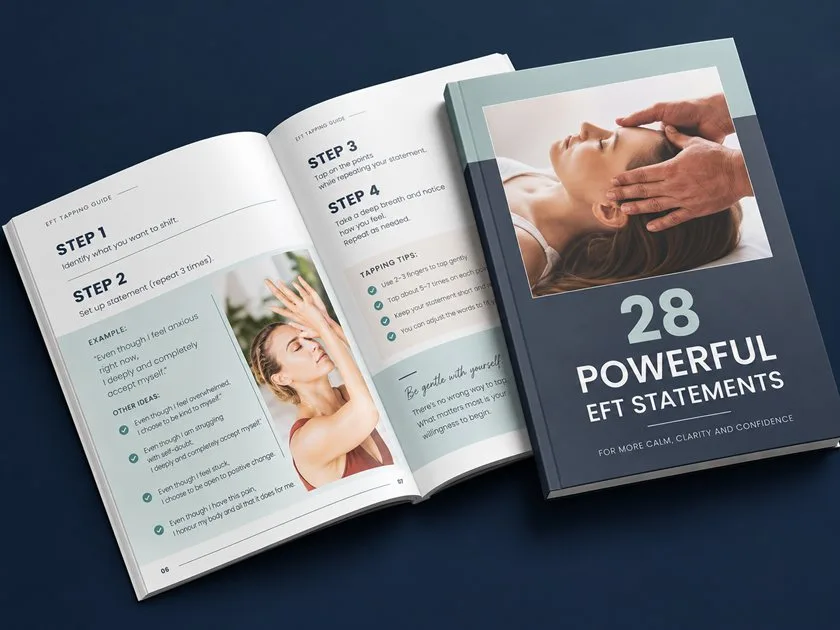
Want to start tapping today?
Grab my free 28 EFT tapping phrases and start clearing stress in the next 10 minutes.
Get the free phrasesWhat can EFT tapping help with?
The research and clinical practice covers a lot of ground. Here’s what EFT tapping has been studied for and shown results with:
- Anxiety and generalised stress
- PTSD and trauma
- Depression
- Phobias and fears
- Chronic pain
- Headaches and tension
- Food cravings and emotional eating
- Performance anxiety (public speaking, exams, sport)
- Sleep issues related to stress
- Burnout
In my practice, the two areas I see the most consistent, dramatic results are anxiety and the physical symptoms that chronic stress creates in the body. Things like digestive issues, muscular tension, headaches, and fatigue that has no obvious physical cause.
That’s because most of these symptoms aren’t just physical. They’re the body holding onto unprocessed emotional stress. And when you start addressing the emotional layer, the physical stuff often follows.
How does EFT tapping work?
Honestly, this is the question I find the most interesting.
There are a few different explanations, and I think they all hold some truth.
The Chinese medicine explanation is that tapping on meridian points stimulates the same energetic pathways as acupuncture. Disruption in these pathways can contribute to emotional and physical symptoms. Tapping, like acupuncture, restores flow.
The neuroscience explanation is that tapping on the body while holding an emotionally activated thought sends a calming signal to the amygdala, the part of your brain that runs your stress response. It’s basically telling your nervous system “you’re safe” while you’re simultaneously facing the thing that triggered it. Over time, the association between that thought or memory and the fear response gets weaker.
The cortisol research supports this. When you tap, stress hormone levels measurably drop. Your body is genuinely calming down, not just feeling like it is.
There’s also a mindfulness element to it. Tapping requires you to tune into your body, name what you’re feeling, and sit with it. That practice alone, of being present with a feeling without running from it, is therapeutic.
Probably all three things are true at the same time. And that’s fine. I don’t need the mechanism to be perfectly mapped out to know that it works.
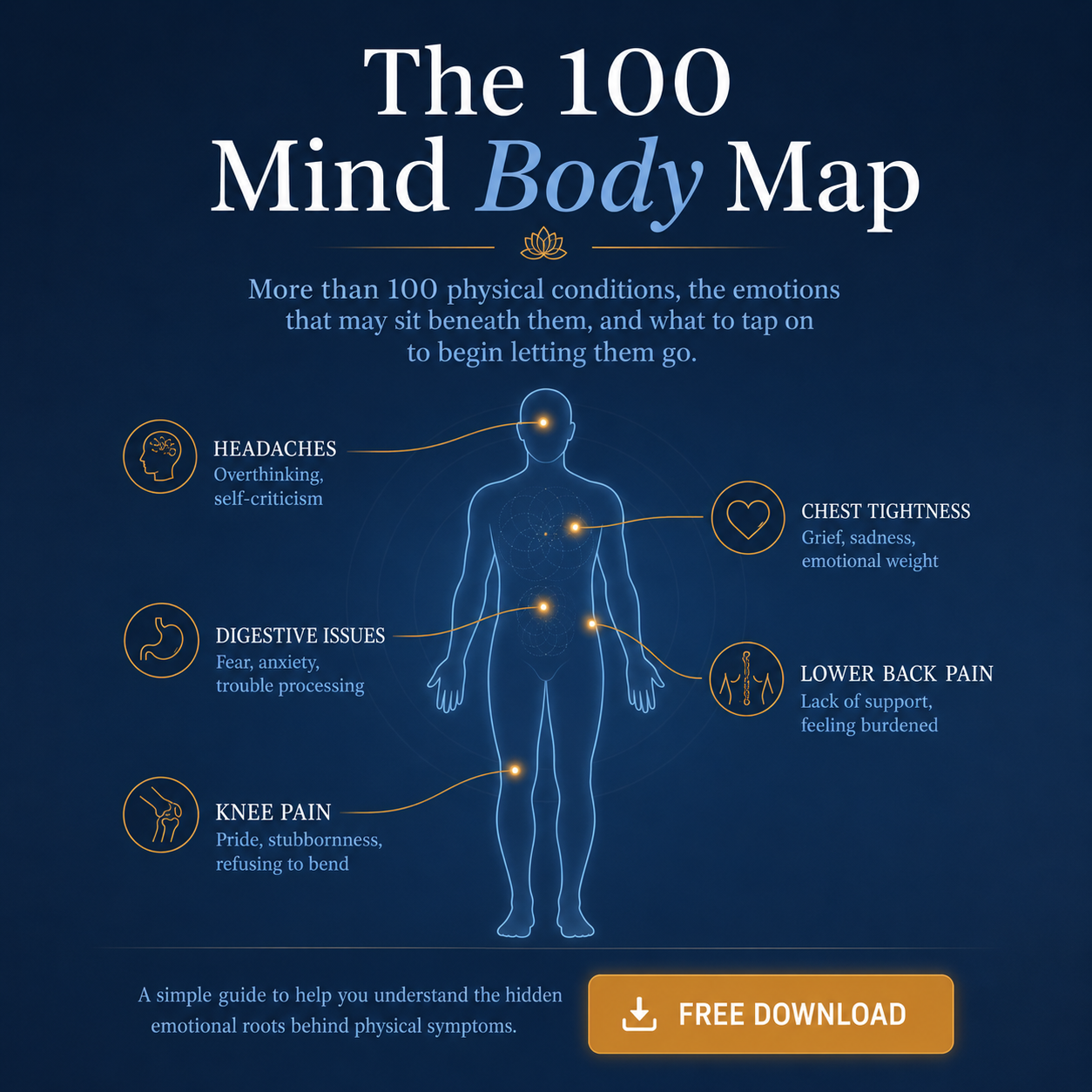
Map the connection between your emotions and your body
The Mind-Body Map shows you exactly where stress and emotions live in your body, and how to release them with EFT.
Get the Mind-Body MapHow do I do EFT tapping?
Here’s the basic process.
- Pick one specific thing. Not “my life is stressful.” More like “the tight feeling in my chest when I think about that conversation yesterday.” The more specific, the better.
- Rate the intensity. On a scale of 0 to 10, how intense is the feeling right now? Write it down or remember it.
- Set up. Tap on the karate chop point (the outer edge of your hand) and say out loud three times: “Even though I have this [feeling or problem], I deeply and completely accept myself.” This acknowledges the problem without fighting it.
- Tap the sequence. Move through the nine points, tapping gently about five to seven times on each one. As you tap, say a short reminder phrase that describes the feeling. Something like “this anxiety,” “this tight feeling,” “this fear.”
- Check in. After one round, rate the intensity again. Has it shifted? Good. Keep going until it drops to a 2 or lower.
One round takes about two minutes. Mild issues might resolve in four or five rounds. Something deeper might take 10 or 12. Some things need ongoing work over days or weeks.
How long does EFT tapping take to work?
This really depends on what you’re working on.
A simple fear or a one-off stressful event? Sometimes one or two sessions is enough to clear it completely.
Chronic anxiety that’s been with you for years? That’s usually built from dozens of layers. Old memories, patterns, beliefs, and events that piled up over time. That takes longer. Not because tapping is slow, but because there’s genuinely more to work through.
In a 2017 survey of EFT practitioners, 63% reported that even complex PTSD could be resolved in 10 sessions or fewer. And the comparison research shows EFT averaging around 3 sessions to achieve what CBT takes 15 sessions to do5.
That said, I’d be doing you a disservice if I promised quick fixes on everything. Some things shift in one session. Some things need months of consistent work. What I will say is this: most people notice something shifting within the first two or three sessions. A softening. A little more space. And that’s worth a lot.

See EFT tapping in action
Watch a free tapping session and follow along. No experience needed.
Watch the free videoIs EFT tapping safe? Are there any side effects?
Yes, EFT tapping is safe.
In all the clinical studies conducted on EFT, including the 2025 systematic review covering over 500 participants, no adverse events were reported. It’s non-invasive, doesn’t require any equipment, and has no medication interactions.
The main thing people notice during a session is that emotions can surface. Sometimes unexpectedly. Tears, yawning, a momentary spike in the feeling before it releases. That’s not a side effect, it’s the process working. Your body is moving something through.
Where people sometimes feel uncomfortable is when they’re working on deeply buried material, especially trauma. In those cases, going too hard too fast on your own can be overwhelming. That’s why for serious trauma, I always recommend working with a trained EFT practitioner rather than trying to navigate it solo.
For everyday stress, anxiety, fears, and emotional relief? You can do this safely on your own.
Can I do EFT tapping at home by myself?
Yes. And that’s honestly one of the things I love most about it.
Once you know the sequence, EFT tapping is completely self-administered. No appointment needed. No equipment. You can do it in your car before a stressful meeting, in bed when your mind won’t switch off, at your desk when work gets overwhelming, or in the bathroom at a family gathering when you need five minutes to reset. (I’ve done all of these.)
The basics can be learned in a single session. And because you’re the one doing it to yourself, you can be honest about what you’re actually feeling in a way that’s sometimes harder in front of someone else.
That said, there’s a difference between doing a round or two of tapping to take the edge off, and doing deep transformational work on your nervous system. The former you can do on your own from day one. The latter benefits from guidance, structure, and knowing how to work through layers.
If you want to start today, grab the free 28 tapping phrases below. That’ll give you a working foundation right away.
Ready to give it a go?
Start with the free 28 EFT tapping phrases. Instant access, no experience needed.
Get the free phrasesWhat is “Mind Body Medicine”?
Mind Body Medicine refers to the interaction between the physical, mental, emotional & energetic dimensions of the human being and how they can influence our overall health and wellbeing.
I primarily work with the mind and emotions and how they are creating disease and discomfort in the body. Around 70% of dis-ease originates from negative patterns in the subconscious mind and from various emotions, like guilt, anger, and resentment that get “stuck” in the body.
When the negative patterns in the subconscious mind are cleaned out and the emotions are “released”, the body tends to heal itself and the mind becomes calmer and quieter.
What if I just meditated a lot, would that help?
Yes, it would. Especially meditation techniques like Vipassana, which means “to observe”. Meditation works in a similar way because it helps to re-wire and re-train the nervous and energy systems of the body so that we no longer impulsively react to emotional and psychological triggers.
However, it usually takes weeks, months or even years of focused meditation practice (with the right teachers) to get to a level where you are cleaning out many of the deepest triggers in your system. EFT and the “letting go” technique can get you there in a matter of hours, or even minutes.

Go deeper with a 90-minute seminar
Guided EFT tapping for one specific problem, from anxiety to chronic pain. Start straight away and keep it for life.
Browse the seminarsAre you offering 1-on-1 sessions?
Not right now, no.
As of late 2026, I’ve stepped back from 1-on-1 work. I’d been fully booked for about six months straight, and honestly, I made the decision to slow down and put more time into family and a few other projects and research I’ve been wanting to dig into.
Will I come back to it? Probably yes. Sometime in 2027 is looking likely, but nothing is locked in yet.
In the meantime, I’ll keep posting on YouTube every month and stay connected with my students. So if you’re working through something, there’s still plenty to keep you going.
And when 1-on-1 sessions do open back up, I’ll let my list know first. So if you’re not on it yet, now’s a good time to get on there.

Want to learn EFT properly?
Train with me in my accredited EFT practitioner training and learn to work with clients, or simply go deeper with your own healing.
Explore practitioner trainingStill have a question that isn’t covered here? Send me a message. I read every one.
Blessings,
Michael Hetherington
Sources
- Choi, Sung & Lee (2025). Emotional Freedom Techniques for Anxiety Disorders: A Systematic Review. Healthcare. pmc.ncbi.nlm.nih.gov/articles/PMC12428011
- Stapleton et al. (2020). Reexamining the Effect of Emotional Freedom Techniques on Stress Biochemistry: A Randomized Controlled Trial. Psychological Trauma: Theory, Research, Practice, and Policy. pubmed.ncbi.nlm.nih.gov/32162958
- Nelms & Castel (2016). A Systematic Review and Meta-Analysis of Randomized and Nonrandomized Trials of Clinical EFT for the Treatment of Depression. Explore. pubmed.ncbi.nlm.nih.gov/27843054
- Church et al. (2013). Psychological Trauma Symptom Improvement in Veterans Using EFT: A Randomized Controlled Trial. Journal of Nervous and Mental Disease. pubmed.ncbi.nlm.nih.gov/23364126
- Chatwin et al. (2016). The Effectiveness of Cognitive Behavioral Therapy and Emotional Freedom Techniques in Reducing Depression and Anxiety Among Adults: A Pilot Study. Integrative Medicine. pmc.ncbi.nlm.nih.gov/articles/PMC4898279